This week, we switched over from astronomy to earth science, and before going into what earth is like today, we talked about earth's history. When it was first formed, it had an atmosphere of helium and hydrogen, like the sun and many of the other planets. But when something the size of Mars hit it, that atmosphere was blown off (and the moon was created by all the debris that was knocked off). Then, gases from inside the planet started coming out (from volcanoes mostly) and made a nitrogen-rich atmosphere, which is like what Saturn's moon Triton still has.

Soon, there was life on earth, which was microscopic bacteria-like things in the oceans, and over time, a lot of oxygen was released. Eventually, there was enough oxygen in the atmosphere for an ozone layer to form. The sun's ultraviolet radiation hits oxygen molecules and sometimes converts them into ozone, and the thick layer of ozone that surrounds earth protects us from a lot of harmful radiation. Only when we had this thick ozone layer could life come out of the oceans onto dry land. Once that happened, all sorts of things happened on earth, including life changing from only microscopic bacteria-like things to a wide variety of living things like plants, animals, fungi, and more.

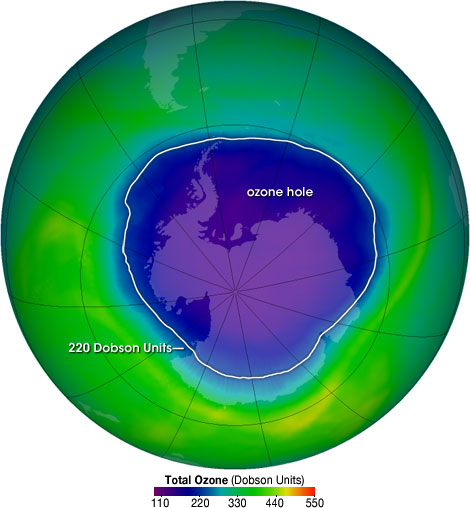
Thanks to that protective ozone layer, things were pretty good for a while, but then people noticed a problem. In the 1950s and 1960s, many products were made using something called CFCs, or chloro-fluorocarbons. These chemicals were used mainly in aerosol spray bottles to get stuff to come out quickly and in refrigerators and air conditioners. Scientists found in the 1970s that these chemicals were quickly damaging the ozone layer by causing large holes to open up. People found a way to monitor the thickness of the ozone layer all over the planet, and were alarmed at how large the hole sometimes got. The biggest hole opens up over the antarctic in the springtime, and it's clear that having a hole in the ozone layer over places where people and other living things try to exist would be really BAD news!!
 |
| This picture shows how large the antarctic ozone hole gets |
So people got to work worldwide to ban chlorofluorocarbons so that we would stop destroying the ozone layer. The first international meeting about it was in March 1977, and in September 1987 the Montreal Protocol was created to specify what chemicals needed to be eliminated and how quickly the world would try to accomplish this. People agreed to work together to make sure we stop destroying ozone and let the ozone layer re-create itself. CFC production in the US ended in 1996 and worldwide in 2010. Scientists forecast the antarctic ozone hole will permanently close around 2050. A global environmental victory!!!

Next, we moved on to talking about clouds and weather. Specifically, we talked about how clouds form. Generally, what happens when clouds form is that warm, moist air that is on the ground rises and gets colder. As the air gets colder, the moisture (water) that's in it begins to collect up. Colder air doesn't hold water as well, and up high in the air, there is less pressure too. Both of these things eventually cause the water to come out of the air and form clouds. Dust in the air starts the whole thing, but clouds are made primarily of water that came out of warm air. There are many different kinds of clouds, named by people for what they look like. We'll be talking about this next.




No comments:
Post a Comment