- a body that circles the sun without being some other object's satellite (that would be a moon)
- is large enough to be rounded by its own gravity
- is not so big that it becomes a star, and
- has cleared up all the other nearby space junk
Pluto's weird orbit
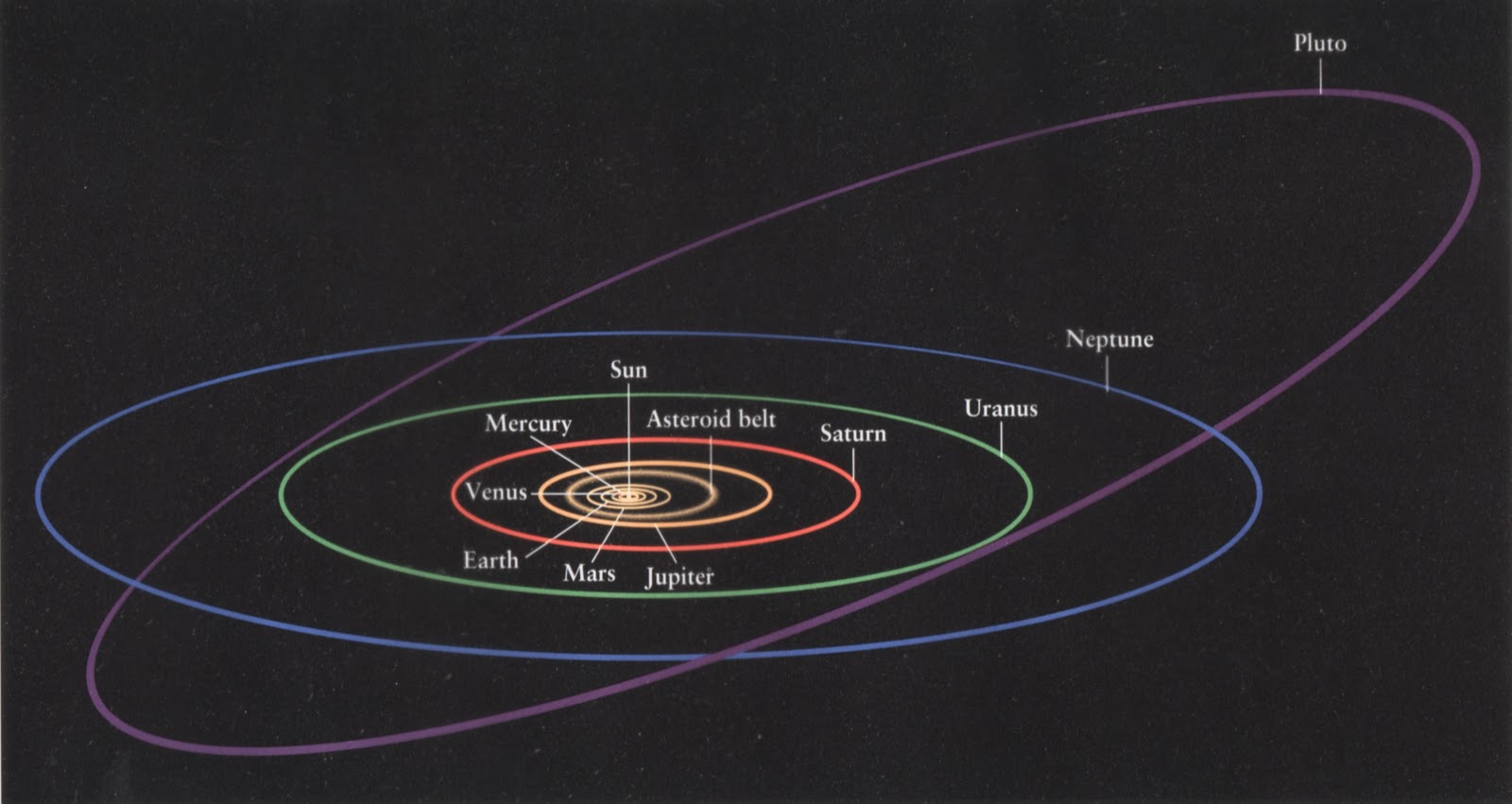
Scientists recently agreed on these conditions because they had to decide if Pluto could still be called a planet. It's much smaller than the others, more the size of our moon, and it turns out there are several other objects slightly larger than Pluto also way out far from the sun in the Kuiper belt (which is a giant collection of space junk/asteroids out beyond Neptune). Pluto also has a weird orbit, but that is not part of why Pluto got demoted. It was because it has not cleared up all the other nearby space junk.
So, we only have 8 planets for now. The first one we discussed in class was Mars, the red planet.
 |
| Mars volcanoes |
- Mars has the largest volcanoes in the solar system, including Olympus Mons, which is huge.
- There are many large valleys, including one gigantic valley, and they were formed by the stretching of the planet's crust early in the formation of the planet.
- There may have been liquid water on the planet, but now there is only ice.
- Frost made of dry ice forms in the winter time. Dry ice is frozen carbon dioxide.
- Mars has seasons but no magnetic field. I think that would make it harder for life on earth to try living on Mars because our life forms have developed within a magnetic field, but I'm not sure.
- Mars has two moons, and the guy who discovered them was an American. In 1877 he searched for them and almost gave up the search. His wife urged him on and he finally saw them. Both are smaller than our moon and are not round.
Mars' two moons - Phobos and Deimos - In the next 50 million years, Phobos, one of the moons, will smash into Mars or break up.
- Many missions have looked at Mars, and two orbiters are staying there.
- Mars might have had life or might still have life, but we aren't sure.

Next, we talked about Jupiter, the gas giant.
- Jupiter is the most massive planet, more than twice the size of all the others combined.
- It would have been a star if it had been 80 times bigger. It is 1300 times the size of the earth.
- Its atmosphere is like the sun, which is helium and hydrogen.
- It has four large moons and many smaller ones -- a total of 63 moons.
- The Great Red Spot is an enormous hurricane, three times the size of earth, that has been going on for over 300 years.
Jupiter's Great Red Spot -- a huge hurricane - Jupiter's magnetic field is 20,000 times stronger than the earth.
- It spins the fastest of all the planets, rotating once every 10 hours, and that makes the planet bulge.
- It broadcasts radio waves that we can detect, and has faint rings around it.
- Jupiter might have flung objects at the inner planets long ago, but in recent times probably protects us from incoming objects.
- There is no evidence of life on Jupiter.

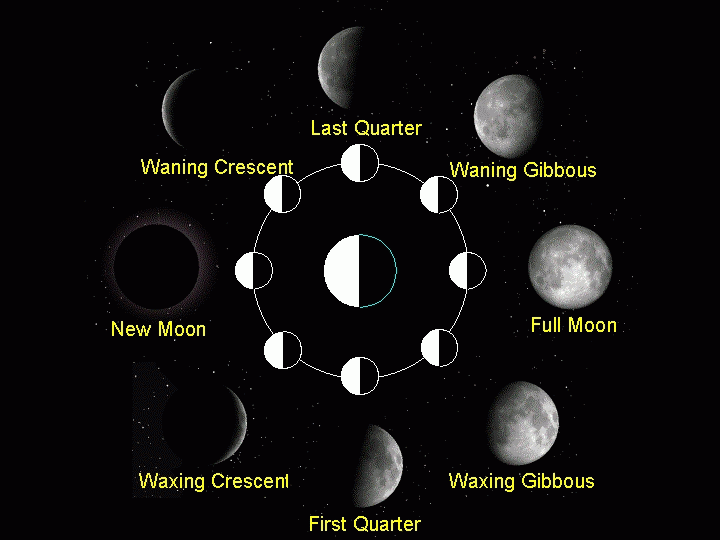
Lastly, we looked at how the phases of the moon work.
- The moon goes around the earth, while the earth is orbiting the sun.
- It takes a month for the moon to have one complete cycle.
- The moon always faces the earth -- it never shows the earth its butt!!!
- The sun always lights up half of the moon, but from earth we only see the whole lit up side once a month. The rest of the time we see part of the lit up side.
- The phases of the moon are:
- New moon -- you can't really see the lit part of the moon at all
Moon phases -- sun is left, earth is in the center - Crescent moon -- you see a sliver of the moon
- Half moon -- you see half the lit part of the moon
- Gibbous -- you see about 3/4 of the lit part of the moon
- Full moon -- you see the whole lit part of the moon, and it looks like a circle